 |
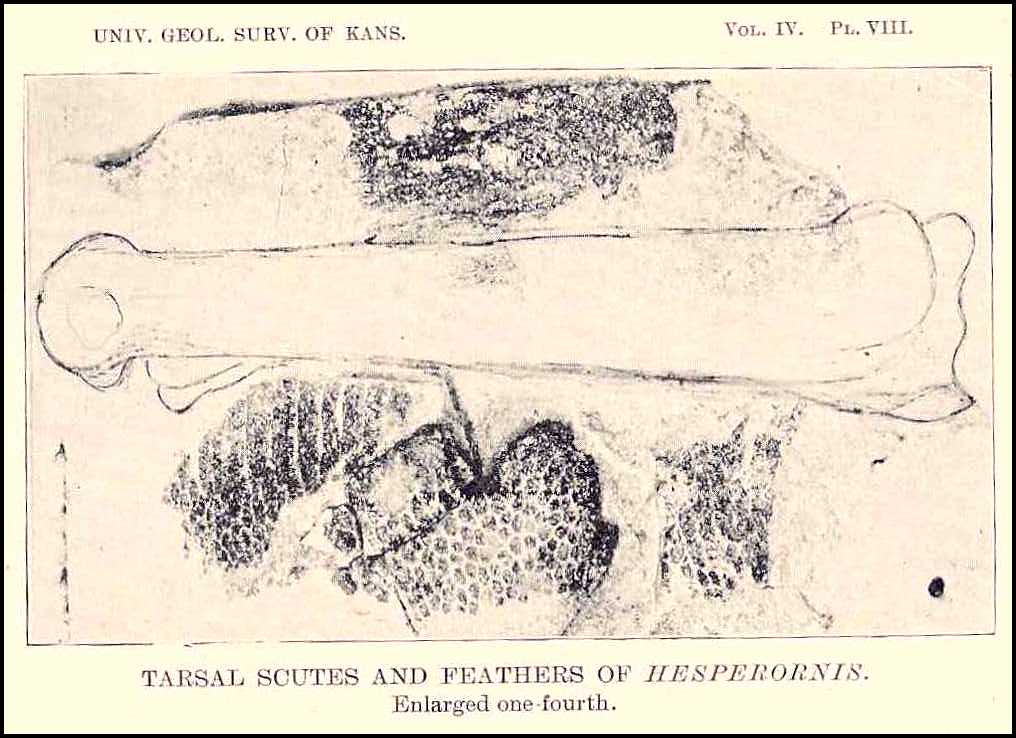
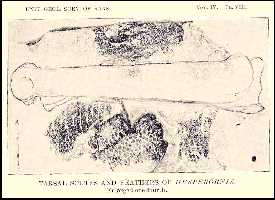
RIGHT: PLATE VIII.--- Photograph of scutes and feather impressions
of the tarsal region of Hesperornis specimen (KUVP 2287) published Williston in
the University Geological Survey of Kansas. Enlarged. S. W. Williston
(1898) wrote "A specimen now in the University Museum, collected by Mr. H. T.
Martin recently [1894, Graham County], is remarkable in showing the scuta of the
tarso-metatarsal region, together with the feathers. A photographic reproduction of this
part of the specimen is shown in Plate VIII. I have sketched in the tarso-metatarsal bone,
to show it's position. Indications of feathers are also seen on the back portion of the
head, and everywhere they appear to be more plumulaceous than the ordinary type of
feathers." (Williston, S. W., 1898. Birds. The University Geological Survey of
Kansas, Part 2, 4:43-53, pls.5-8.) See also Williston,
1898, On
the dermal covering of Hesperornis.
NOTE: KUVP 2287 was re-described by Larry Martin (1984) as the type specimen of
a new genus and species of hesperornithid bird, Parahesperornis alexi.
Martin, L.D.
1984. A new hesperornithid and the relationships of the Mesozoic birds. Kansas Academy of
Science, Transactions 87:141-150. |
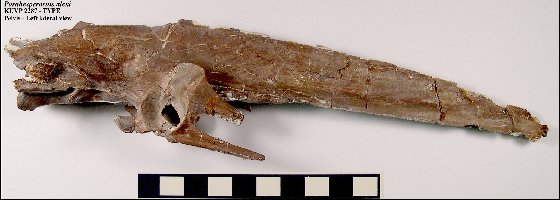 |
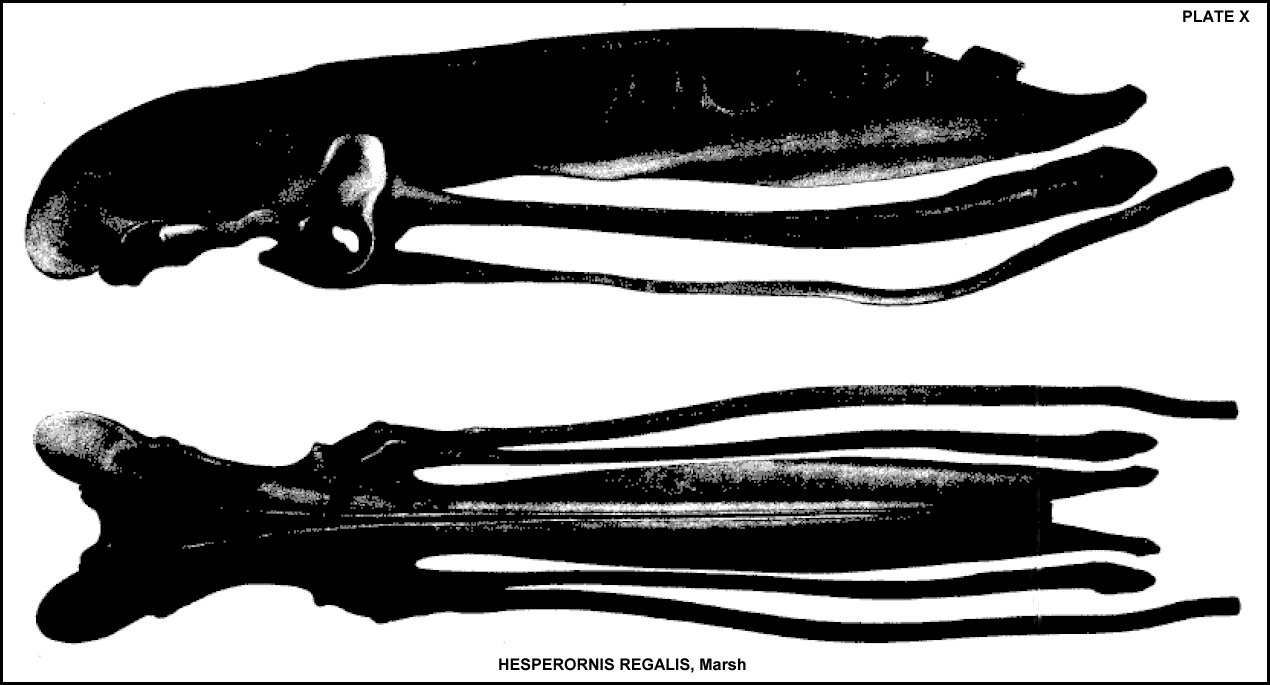
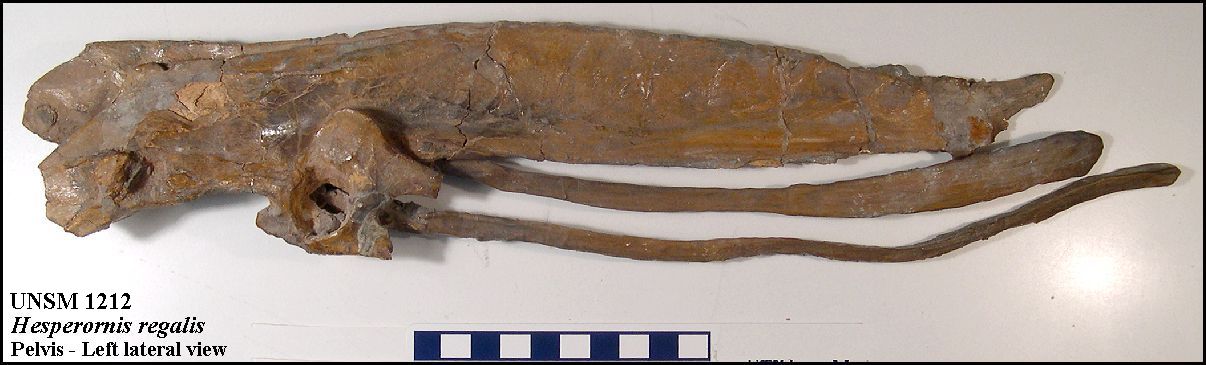
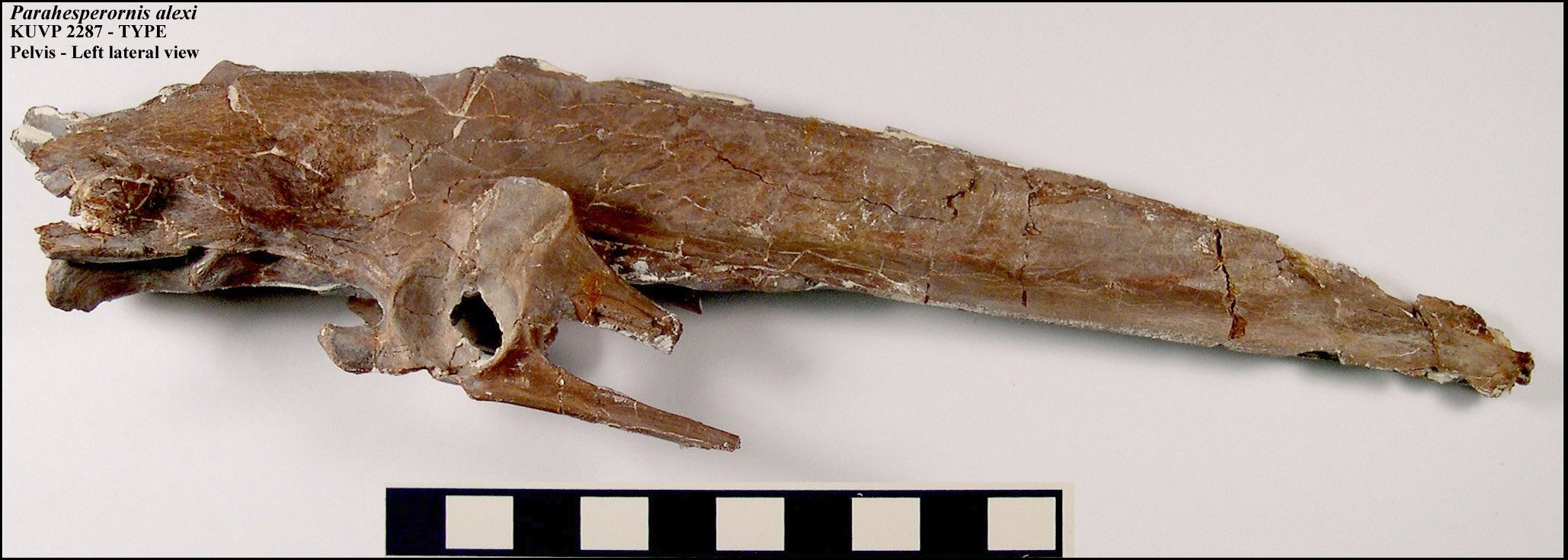
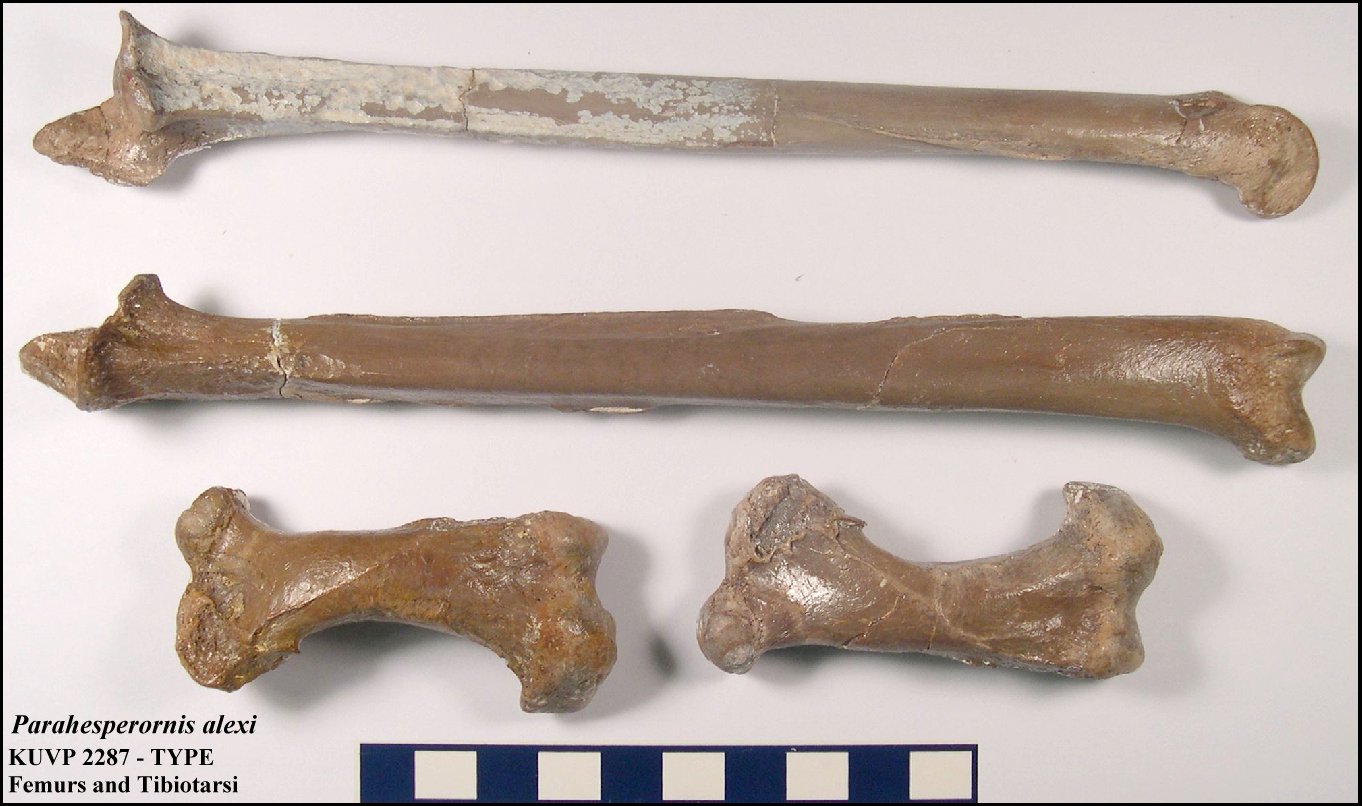
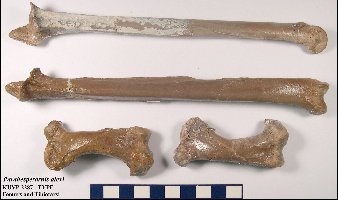
LEFT: The pelvis of the type of Parahesperornis alexi (KUVP
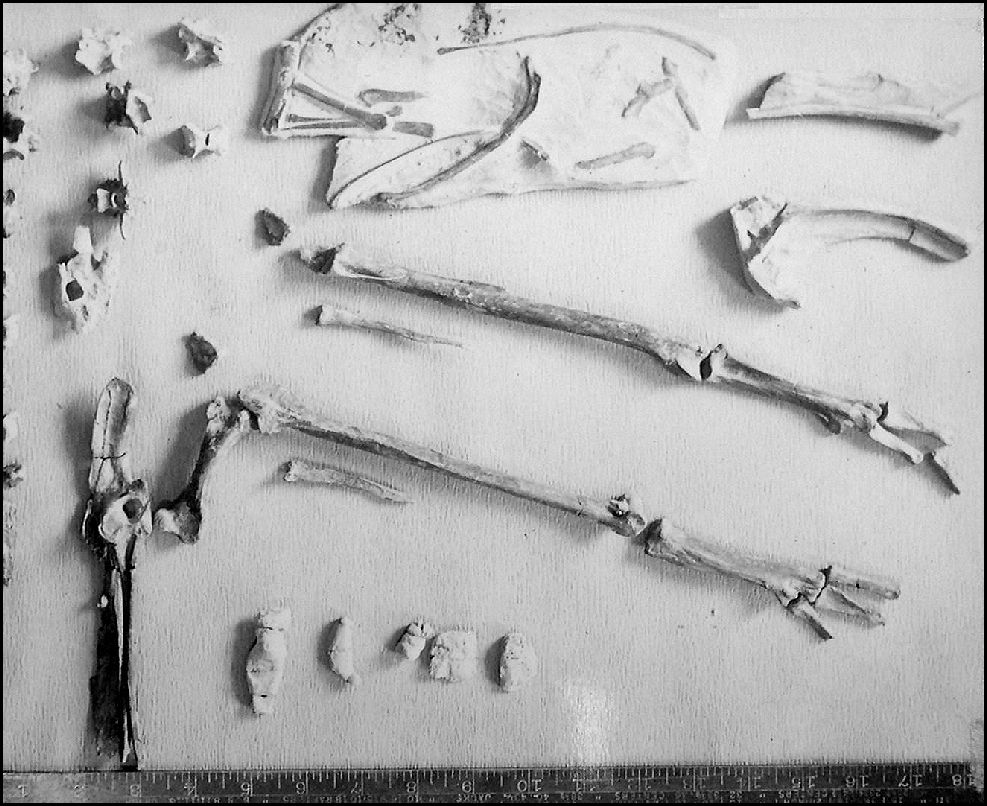
2287) in left lateral view. RIGHT: The femurs and tibiotarsi of KUVP
2287 |
 |
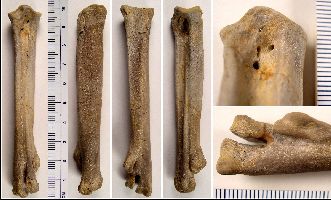 |
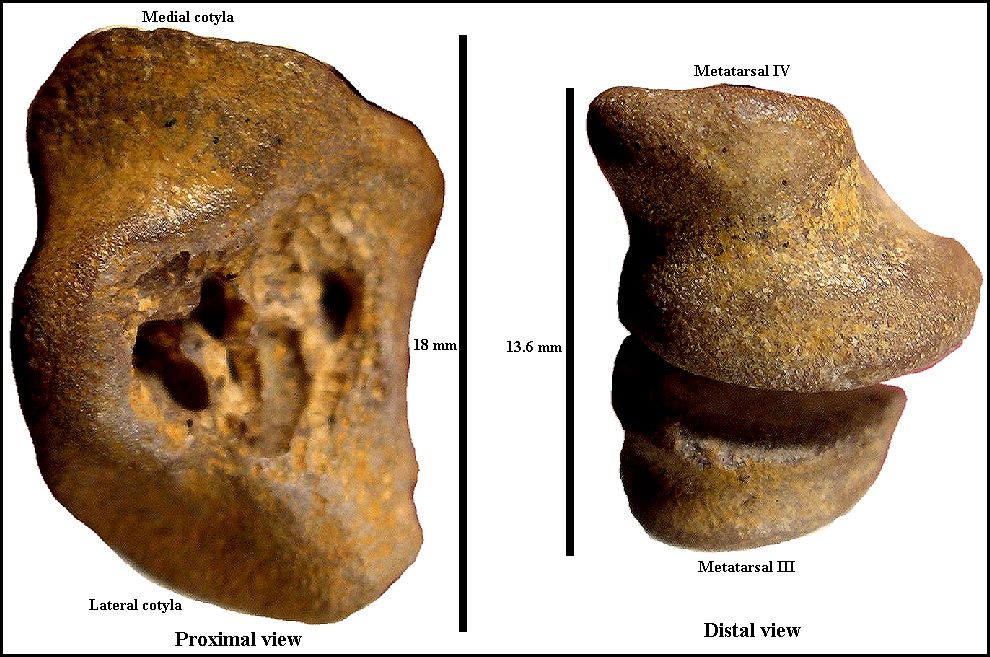
LEFT: The right tarsometatarsus of Parahesperornis sp.
(FHSM VP-17312) collected by Pete Bussen in the upper Smoky Hill Chalk (MU 22) of western
Logan County. This lower limb bone is about 9.7 cm in length and came from a medium-sized
swimming bird about the size of a modern cormorant. RIGHT: Proximal
and distal end views of the same specimen. The proximal end appears to have a possible
pathology that has destroyed the bone surface in the center of the joint.
See: Bell, A. and Everhart, M.J. 2009. A new
specimen of Parahesperornis (Aves: Hesperornithiformes) from the Smoky Hill Chalk
(Early Campanian) of western Kansas. Kansas Academy of Science, Transactions
112(1/2):7-14. |
 |
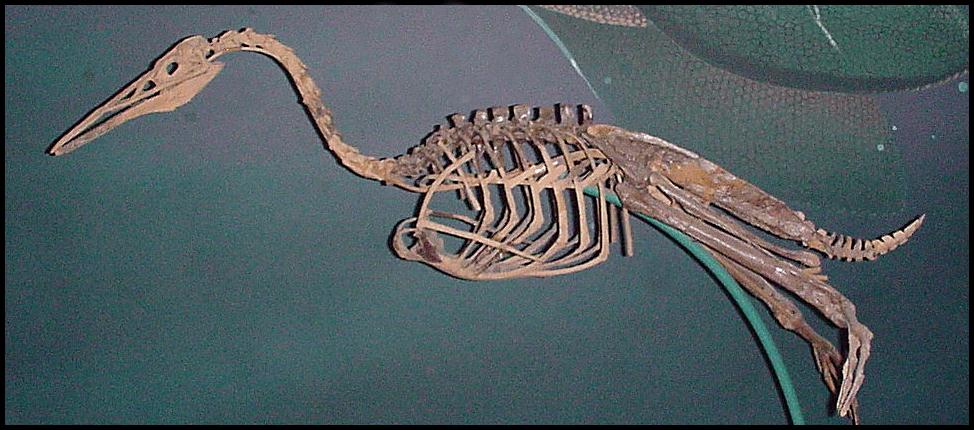
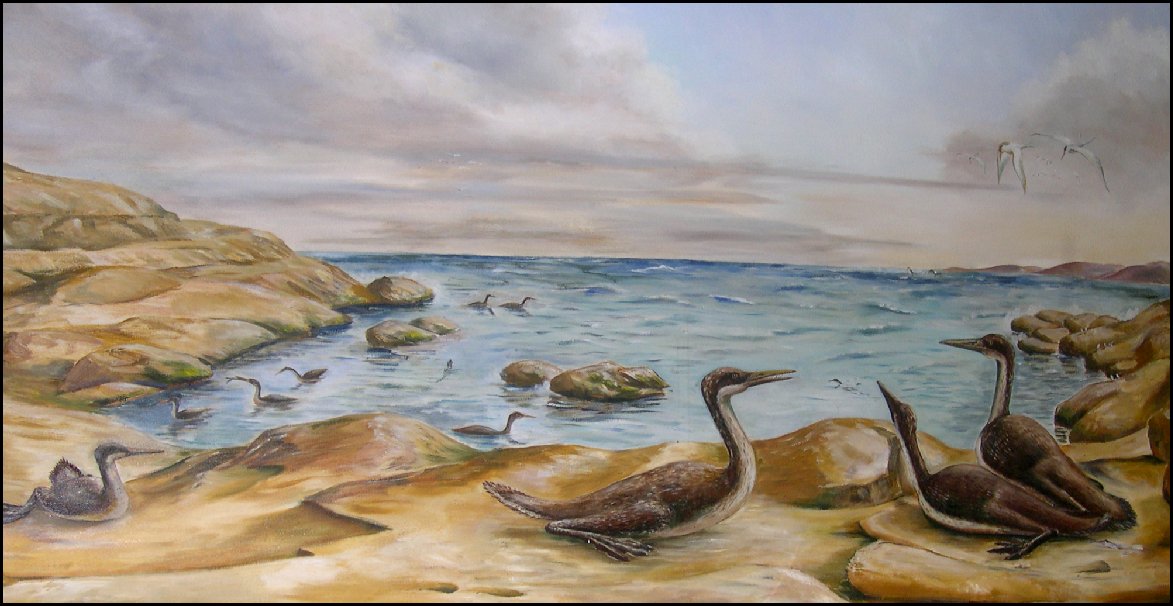
Baptornis varneri Martin and
Cordes-Person, 2007
| This new species of Baptornis was described by James
Martin and Amanda Cordes-Person from a specimen discovered some years ago by Dan Varner in the Pierre Shale of western South Dakota. Martin, J. E. and Cordes-Person, A. 2007. A new species
of the diving bird Baptornis (Ornithurae:
Hesperornithiformes) from the lower Pierre Shale Group (Upper Cretaceous) of southwestern
South Dakota. The Geological Society of America, Special Paper 427: 227-237.
ABSTRACT:
"Fossil
birds are relatively rare in Cretaceous deposits of the Northern Great Plains, so the
discovery of a large, new diving bird was unexpected. From marine deposits of the Niobrara
Formation in Kansas small diversity of birds was known, but until now the large diving
bird, Hesperornis was the only bird taxon
known from the Pierre Shale Group of South Dakota. The new discovery, a partial skeleton
of another diving bird, Baptornis, was secured
from the Sharon Springs Formation (lower middle Campanian) of the Pierre Shale Group in
Fall River County, South Dakota. The specimen is represented by vertebrae, pelvic
fragments, and lower leg elements that are similar to but much more robust than Baptornis advenus from the subjacent Niobrara
Formation. The new taxon is nearly twice the size of the Niobrara species, principally in
robustness rather than in length of elements. Overall, the specimen represents the first
occurrence of Baptornis from the Pierre Shale Group, represents a new species,
and indicates greater diversity of birds from the Pierre Shale Group than was previously
known."
Etymology: Named for Daniel
Varner who found the specimen, and for his notable contributions to paleontology in the
form of artistic renderings of extinct vertebrates. |
A very early Enaliornis-like bird from North America (The
oldest bird remains in the United States)
Enaliornis (Seeley, 1876) is a genus of hesperornithine birds from the
Early Cretaceous Cambridge Greensand of England. Two species have been described: Enaliornis
barretti and E. sedgwicki. Although remains are fragmentary and
incomplete, this is currently the oldest known hesperornithine. In June, 1979, two
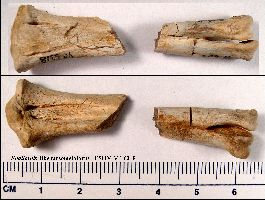
fragments of a Enaliornis-like tarsometatarsus were surface collected from the
basal Lincoln Limestone Member of the Greenhorn Limestone in western Russell County,
Kansas. The limb bone would have come from a swimming bird somewhat smaller than Hesperornis
or Baptornis. The specimen was mentioned by Martin (1983) and Tokaryk, et al.
(1997) but was never fully described or figured. The English Enaliornis material
was re-described more recently by Galton and Martin (2002).
See: Everhart, M.J. and Bell, A. 2009. A hesperornithiform limb
bone from the basal Greenhorn Formation (Late Cretaceous; Middle Cenomanian) of north
central Kansas. Journal of Vertebrate Paleontology 28(3):952-956.
 |
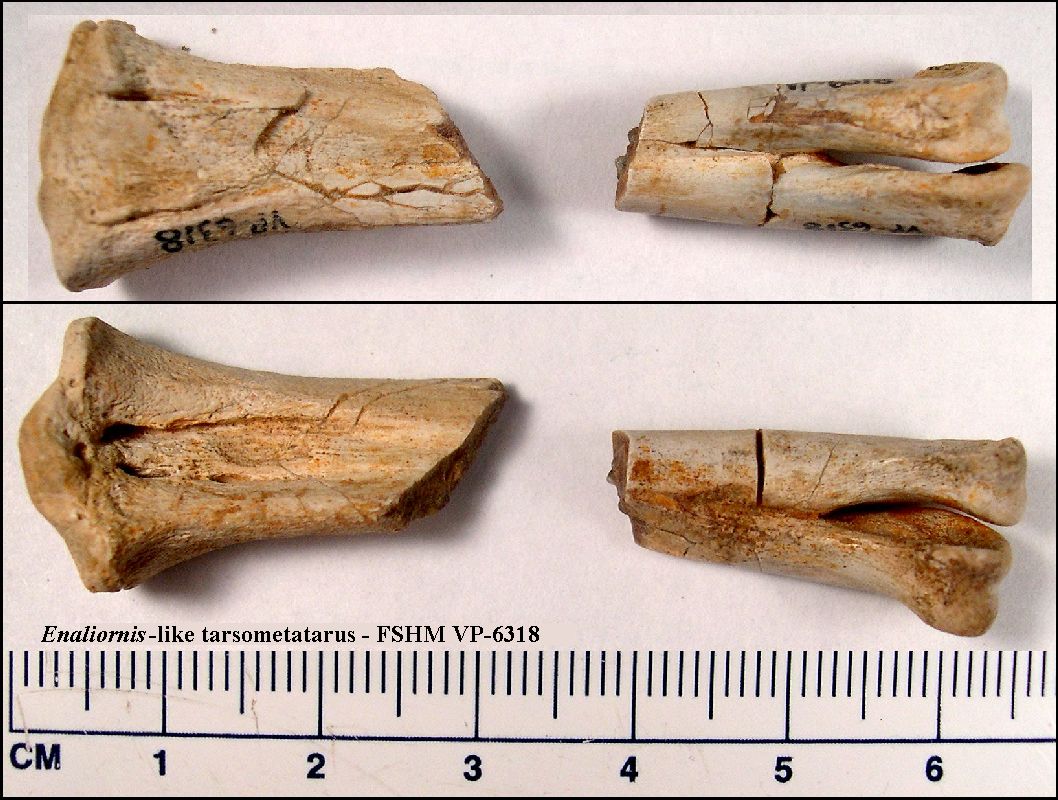
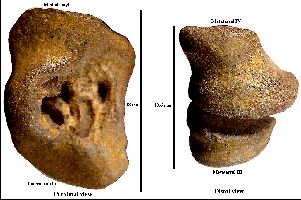
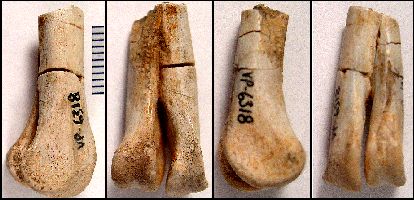
LEFT: Two views of the proximal and distal ends of the right
tarsometatarsus (FHSM VP-6318) of an Enaliornis-like bird from the basal
Greenhorn Limestone (Middle Cenomanian) of Kansas. This specimen represents the oldest
bird bone in Kansas and the United States, and is almost as old as the material
described from the Carrot River area in Saskatchewan, Canada by Tokaryk, et al., 1997, which is currently
the oldest bird fauna in North America. Their specimens also included an Enaliornis-like
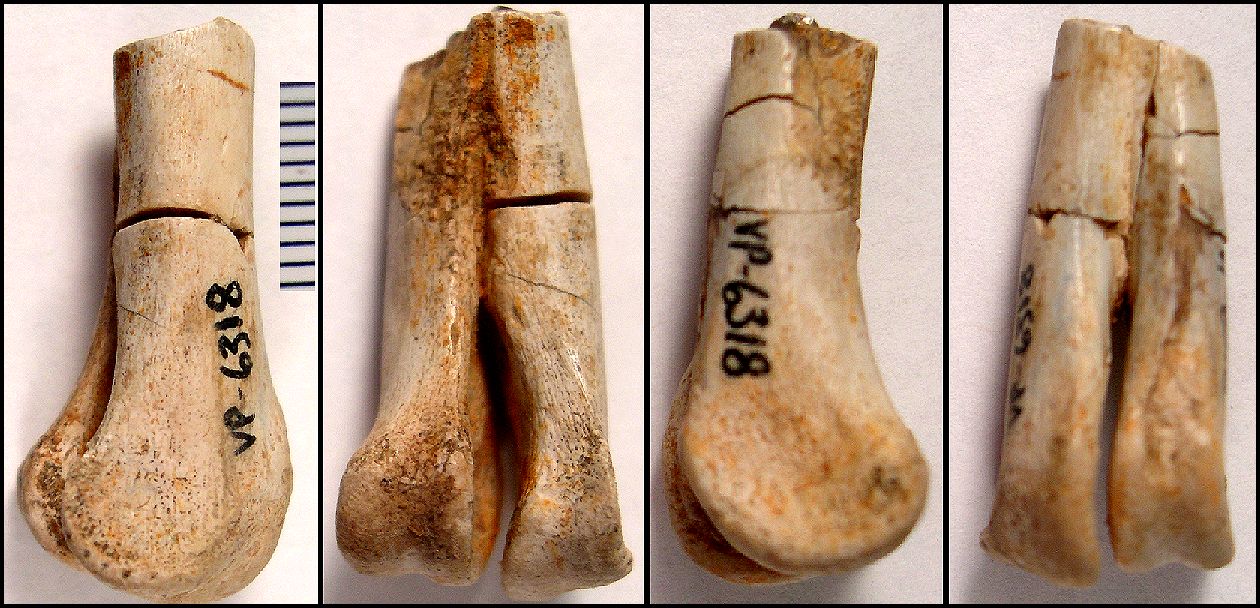
bird. (Everhart and Bell, 2009) RIGHT: Four views of the distal end of
the specimen. The
tarsometatarsus is a bone in the lower leg of birds. It is formed from
the fusion of several bones homologous to the ankle (tarsal) and foot (metatarsal) of
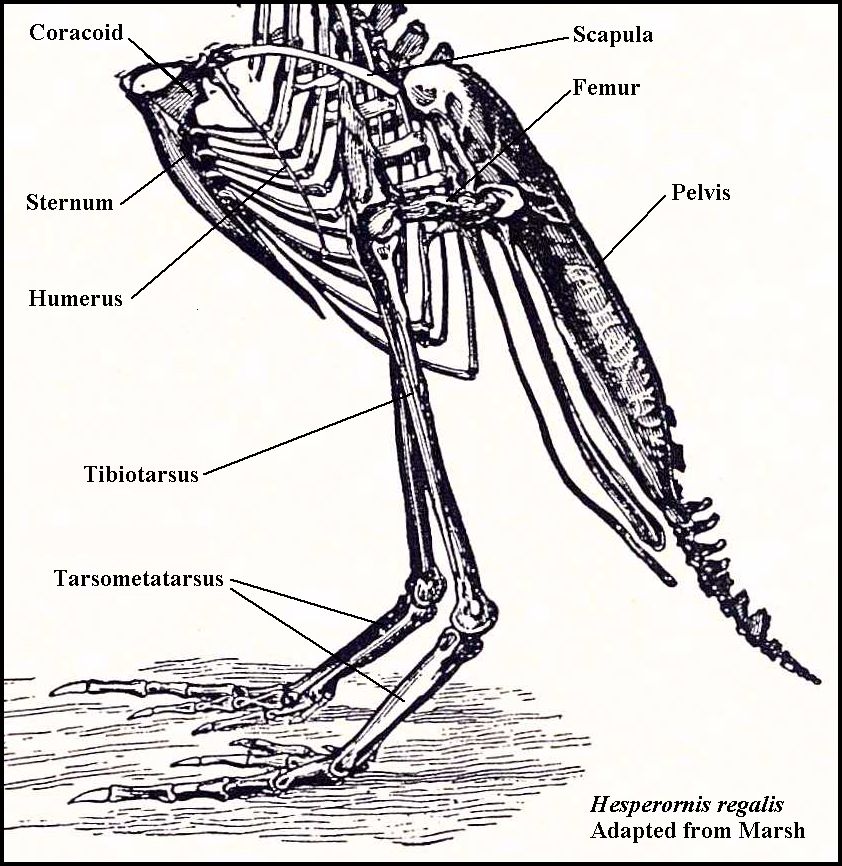
mammals. (See skeletal drawing of a Hesperornis leg HERE) |
 |
References:
American
Ornithologists’ Union. 1910. Checklist of North American birds; 3rd edition. American
Ornithologists’ Union, New York, 430 pp.
Anonymous. 1891. Professor [D. W.] Thompson
on the systematic position of Hesperornis. Auk 8(3): 304-305.
Baird,
D. 1967. Age of fossil
birds from the Greensands of New Jersey. Auk 84(2): 260-262
Bell, A. and Everhart, M.J. 2009. A new
specimen of Parahesperornis (Aves: Hesperornithiformes) from the Smoky Hill Chalk
(Early Campanian) of western Kansas. Kansas Academy of Science, Transactions
112(1/2):7-14.
Bell, A. and Everhart,
M.J. 2011. Remains of small ornithurine birds from a Late Cretaceous
(Cenomanian) microsite in
Russell County, north-central
Kansas. Kansas
Academy
of Science, Transactions 114(1-2):115-123.
Brodkorb, P. 1971. Origin and evolution of birds; pp. 19-55 in D. S. Farner and J. R. King (eds.), Avian Biology,
Volume 1, Academic Press, New York.
Bryant, L.J. 1983. Hesperornis in Alaska. PaleoBios 40:1-8.
Bühler, P., Martin, L.D. and Witmer, L.M. 1988. Cranial kinesis in the
Late Cretaceous birds Hesperornis and Parahesperornis. Auk 105 p.
111-122. (PDF of paper available on-line)
Chinsamy, A., Martin L.D. and Dodson, P. 1998. Bone
microstructure of the diving Hesperornis and the volant Ichthyornis from
the Niobrara Chalk of western Kansas. Cretaceous Research 19:225-235.
Cracraft, J. 1982. Phylogenetic relationships
and monophyly of Loons, Grebes, and Hesperornithiform birds, with comments on the early
history of birds. Systematic Zoology 31(1):35-56.
Cumbaa, S. L., Schröder-Adams, C.,
Day, R.G. and Phillips, A. 2006. Cenomanian bonebed faunas from the Northeastern margin,
Western Interior Seaway, Canada; pp. 139-155 in S. G. Lucas, and R. M. Sullivan (eds.), Late Cretaceous
vertebrates from the Western Interior. New Mexico Museum of Natural History and Science
Bulletin 35.
Elzanowski,
A. and Brett-Surman, M.K. 1995. Avian premaxilla and
tarsometatarsus from uppermost Cretaceous of Montana. Auk 112(3):762-767.
Everhart, M.J. 2005. Oceans of Kansas - A Natural History of the Western Interior
Sea. Indiana University Press, 322 pp.
Everhart, M.J. 2011. Rediscovery
of the Hesperornis regalis Marsh 1871 holotype locality indicates an
earlier stratigraphic occurrence.
Kansas
Academy
of Science, Transactions 114(1-2):59-68.
Everhart, M.J. and Bell, A. 2009. A hesperornithiform limb bone from
the basal Greenhorn Formation (Late Cretaceous; Middle Cenomanian) of north central
Kansas. Journal of Vertebrate Paleontology 28(3):952-956.
Fox,
R.C. 1974. A middle Campanian, nonmarine occurrence of the Cretaceous toothed
bird Hesperornis Marsh. Canadian
Journal of Earth Sciences 11:1335-1338.
Fürbringer, M. 1888.
Untersuchungen zur Morphologie und Systematik der Vögel, zugleich ein Beitrag zur
Anatomie der Stütz – und Bewegungsorgane; Verlag von Tl.J. Van Holkema, Amsterdam, 1751 p.
Galton, P.M. and
Martin, L.D. (2002): Enaliornis, an Early Cretaceous Hesperornithiform bird from
England, with comments on other Hesperornithiformes. pp. 317-338 in Chiappe, L.M.
and Witmer, L.M. (eds.): Mesozoic Birds: Above the Heads of Dinosaurs. University
of California Press, Berkeley, Los Angeles, London.
Gingerich, P.D. 1973. Skull of Hesperornis and early
evolution of birds. Nature 243:70-73.
Gingerich, P.D. 1975. Evolutionary significance of
the Mesozoic toothed birds. Smithsonian Contributions to Paleobiology 27:23-34.
Gregory, J.T. 1951. Convergent evolution: The jaws of Hesperornis
and the mosasaurs. Evolution, 5:345-354.
Gregory, J.T. 1952. The jaws of the
Cretaceous toothed birds Ichthyornis and Hesperornis. Condor
54(2):73-88, 9 figs., 1 table.
Heilmann,
G. 1926. Origin of Birds. H.F. &
B. Witherby, London, 208 pp.
Hieronymus, T.L. and Witmer, L.M. 2010. Homology and
evolution of avian compound rhamphothecae. Auk 127(3):590-604.
Lane, H.H. 1946. A survey of the fossil vertebrates of Kansas,
Part IV, The Birds, Kansas Academy of Science, Transactions 49(4):390-400.
Marsh, O.C. 1872. Discovery of a remarkable fossil bird. American Journal of
Science, Series 3, 3(13): 56-57.
Marsh, O.C. 1872. Preliminary description of Hesperornis regalis, with notices
of four other new species of Cretaceous birds. American Journal of Science 3(17):360-365.
Marsh, O.C. 1873. Fossil birds from the Cretaceous of North
America. American Journal of Science, Series 3, 5(27):229-231.
Marsh, O.C. 1875. On the Odontornithes, or birds with teeth.
American Journal of Science, Series 3, 10(59):403-408, pl. 9-10.
Marsh, O.C. 1876. Notice of new Odontornithes. The American
Journal of Science and Arts 11:509-511.
Marsh, O.C. 1877. Characters of the Odontornithes, with notice of
a new allied genus. American Journal of Science 14:85-87, 1 fig. (Naming and
description of Baptornis advenus)
Marsh, O.C. 1880. Odontornithes:
A monograph on the extinct toothed birds of North America. U.S. Geol. Expl. 40th
Parallel (King), vol. 7, xv + 201 p., 34 pl. (Synopsis of American Cretaceous birds,
appendix 191-199)
Marsh, O.C. 1883. Birds with Teeth. 3rd Annual Report of the
Secretary of the Interior, 3: 43-88. Government Printing Office, Washington, D.C.
Marsh,
O.C. 1893. A new Cretaceous bird allied to Hesperornis.
American Journal of Science 45:81-82.
Martin, J.E. 1982. The occurrence of Hesperornis in the
late Cretaceous Niobrara Formation of South Dakota. Proceedings of the South Dakota
Academy of Science 71(95-97).
Martin, J.E. and Cordes-Person, A.
2007. A new species of the diving bird Baptornis (Ornithurae:
Hesperornithiformes) from the lower Pierre Shale Group (Upper Cretaceous) of southwestern
South Dakota. The Geological Society of America, Special Paper 427:227-237.
Martin, J. E. and Varner, D. W. 1992.
The occurrence of Hesperornis in the Late
Cretaceous Niobrara Formation of South Dakota. Proceedings of the South Dakota Academy of
Science 71:95-97.
Martin, J.E. and Varner, D. W. 1992.
The highest stratigraphic occurrence of the fossil bird Baptornis. Proceedings of the South Dakota Academy
of Science 71:167 (abstract).
Martin, L.D. 1980. Foot-propelled diving birds of the Mesozoic;
pp. 1237-1242 in Acta XVII Congress of International Ornithology.
Martin, L.D. 1983. The origin
and early radiation of birds. Chapter
9 (pp 291-338) in Bush, A. H. and
Clark, G. A., Jr. (eds.), Perspectives in
Ornithology. Cambridge University Press, Cambridge.
Martin, L.D. 1984. A new hesperornithid and the
relationships of the Mesozoic birds. Kansas Academy of Science, Transactions 87:141-150.
Martin, L.D.,
Kurochkin, E.N. and Tokaryk, T.T. 2012. A new evolutionary lineage of diving
birds from the Late Cretaceous of North America and Asia. Palaeoworld 21
(1):59–63.
Martin, L.D. and Bonner, O. 1977. An immature specimen of Baptornis
advenus from the Cretaceous of Kansas. The Auk 94:787-789.
Martin, L.D. and Stewart, J.D. 1996. Implantation and replacement of
bird teeth. Smithsonian Contributions to Paleobiology 89:295-300.
Martin, L.D. and Tate, J., Jr. 1966. A bird with teeth. Museum
Notes, University of Nebraska State Museum, 29:1-2.
Martin, L.D. and Tate, J., Jr. 1976. The
skeleton of Baptornis advenus (Aves: Hesperornithiformes). Smithsonian
Contributions to Paleobiology 27:35-66.
Mudge, B.F. 1877. Annual Report of the Committee on
Geology, for the year ending November 1, 1876. Kansas Academy of Science,
Transactions, Ninth Annual Meeting, pp. 4-5. (discovery of Uintacrinus socialis
in Kansas, Pteranodon, sharks and birds.)
Rees,
J. and Lindgren,
J. 2005. Aquatic birds from the upper Cretaceous (Lower Campanian) of Sweden and
the biology and distribution of Hesperornithiforms. Palaeontology 48:1321-1329.
Reynaud, F. 2006. Hind limb and pelvis proportions of Hesperornis
regalis: A comparison with extant diving birds. Journal of Vertebrate Paleontology 26(3):115A.
Reynaud, F.N. 2006. Hind limb and
pelvis proportions of Hesperornis regalis:
A comparison with extant diving birds. Unpublished Masters Thesis, Fort Hays
State University, Hays, Kansas. 45 pp.
Seeley, H.G. 1876. On the British fossil Cretaceous birds. Quarterly Journal of the
Geologic Society of London 32:496-512.
Shufeldt, R.W. 1915. The fossil remains of a
species of Hesperornis found in Montana. Auk 32(3):290-284.
Shufeldt, R.W.
1915. Fossil Birds in the Marsh Collection of Yale University. Transactions of the Connecticut Academy of Arts and
Sciences 19:1-110, 15 pl.
Shufeldt,
R.W. 1915. On a restoration of the base of the cranium of Hesperornis
regalis. Bulletins of American
Paleontology 5:73-85, plates 1-2.
Snow, F.H. 1887. On the Discovery of a Fossil Bird Track
in the Dakota Sandstone. Kansas Academy of Science, Transactions 10:3-6
Sternberg, C.H. 1917. Hunting Dinosaurs in the Badlands of the
Red Deer River, Alberta, Canada. Published by the author, San Diego, Calif., 261 pp.
Thompson,
D’A. W. 1890. On the systematic
position
of Hesperornis. University
College, Dundee, Studies from the
Museum
of
Zoology
10:1-15, 17 figs.
Tokaryk, T.T., Cumbaa, S.L. and Storer, J.E. 1997.
Early Late Cretaceous birds from Saskatchewan, Canada: the oldest diverse avifauna known
from North America. Journal of Vertebrate Paleontology, 17:172-176.
Townsend, C.W. 1909. The use of the wings and
feet by diving birds. Auk 26(3):234-248.
Walker, M.V. 1967. Revival of interest in the toothed birds of Kansas.
Kansas Academy of Science, Transactions 70(1):60-66.
Williston, S.W. 1896. On the dermal covering of
Hesperornis. Kansas University Quarterly 5(1):53-54, pl. II.
Williston, S.W. 1898. Birds. The
University Geological Survey of Kansas, Part 2, 4:43-53, pls.5-8.
Williston, S.W. 1898. Bird tracks from the Dakota Cretaceous. The
University Geological Survey of Kansas, Part II, 4:50-53, Fig. 2. (Re-publication of
photograph originally published by Snow, 1887)