 |
OCEANS OF KANSAS PALEONTOLOGY Fossils from the Late Cretaceous Western Interior Sea The entire Oceans of Kansas web site is Copyright © 1996-2017 by Mike Everhart (mike at oceansofkansas.com) TWENTY YEARS ON THE INTERNET! (On the Web since December, 1996) Last updated 12/20/2017
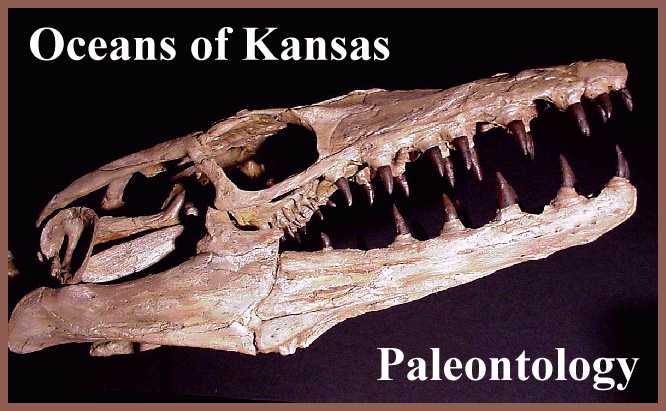
OCEANS OF KANSAS: A Natural History of the Western Interior Sea - THE BOOK (Published 2005) LEFT: FHSM VP-13910, Selmasaurus johnsoni, Polcyn and Everhart (2008), a new species of mosasaur from the Smoky Hill Chalk of western Kansas |
The 2nd Edition of Oceans of Kansas - A Natural History of the Western Interior Sea will be published in September, 2017. The updated book will be larger, with more figures, descriptions of new discoveries in the past 12 years, and an in depth look at the history of Late Cretaceous paleontology in Kansas. I'm very pleased that the Indiana University Press has given me the opportunity to bring Oceans of Kansas up to date.
IMPORTANT NOTE: As mentioned above, this website is now over twenty years old, older than some of its readers. Unfortunately, HTML technology changes rapidly and my old Microsoft FrontPage HTML editor is no longer supported. Worse yet, my two hundred plus web pages cannot be easily translated into a new text editor, and I am too old to start it over - not to mention that my cool digital photos from the early years are not so cool anymore. So the bottom line is that Oceans of Kansas cannot be updated easily, and will eventually fade from the Internet. It has been a wonderful 20 years.
 |
Welcome to the Oceans of
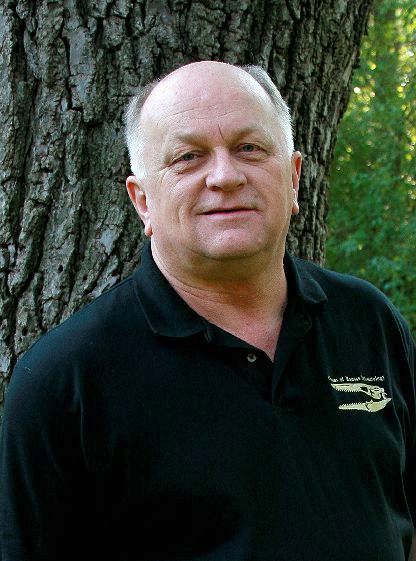
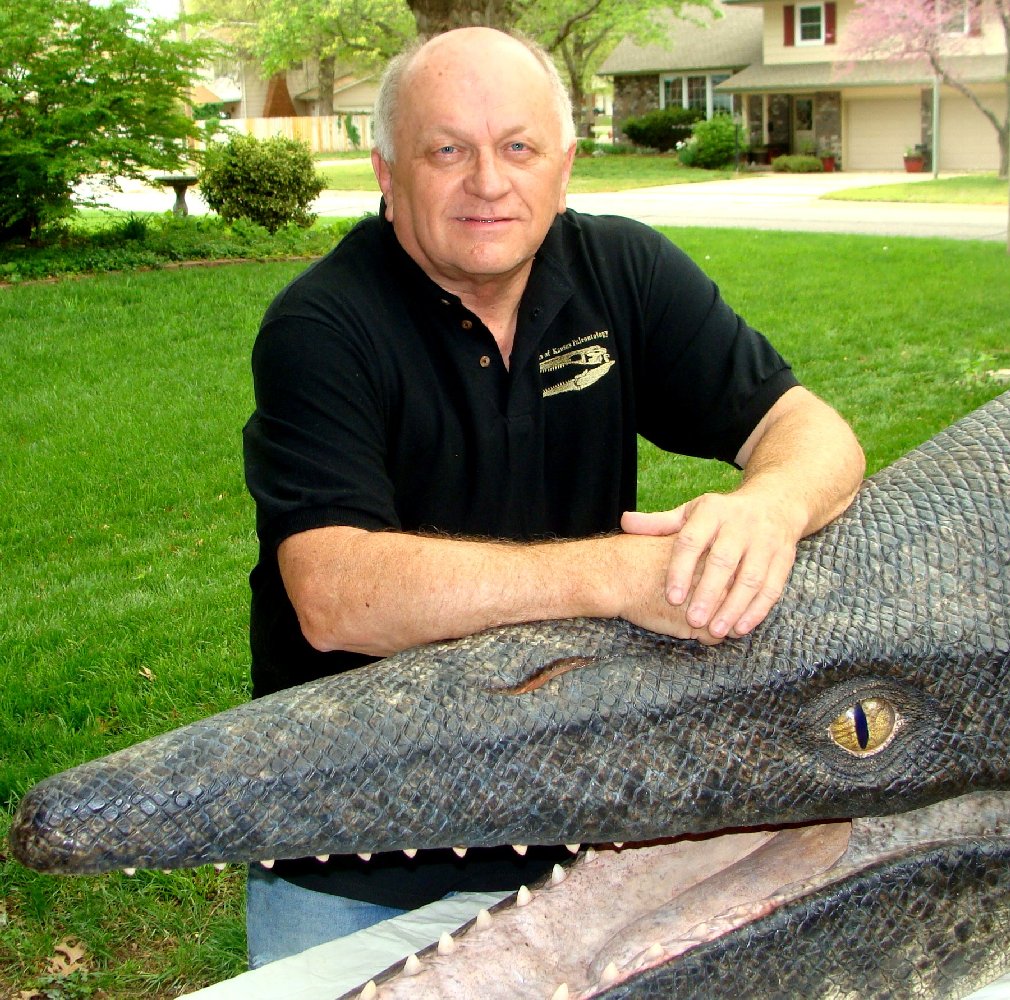
Kansas Paleontology web page. My name is Mike Everhart and I am your
host on a virtual journey more than 85 million years "back in time" to
observe some of the many strange and wonderful creatures that lived in the oceans of the
Earth during the final stages of the Age of Dinosaurs. I have collected
fossils from the Smoky Hill Chalk of western Kansas for the last thirty-plus years and
have been an Adjunct Curator of Paleontology at the Sternberg Museum of Natural History in Hays, Kansas since 1998. I was twice President (2005 and 2015) of the Kansas
Academy of Science, and have served as a co-editor of the Transactions of the
Kansas Academy of Science from 2006 through the present (2017). Currently my wife and I are managing editors of the Transactions. The TKAS is one of the oldest science journals in the United States (est. 1872). I have conducted a Paleontology Symposium at the past eighteen annual meetings (2000-2017) of the Kansas Academy of Science (Abstracts of the 12th Paleo-symposium (2011) here), and the Second Mosasaur Meeting in May, 2007 (below). Note that most of the information available on this website is published my 2005 book, Oceans of Kansas - A Natural History of the Western Interior Sea. (LEFT) The 2nd Edition of Oceans of Kansas is due to be published by the Indiana University Press in September, 2017. The 2nd Edition is extensively updated and 25% larger than the first edition, with more photos of fossils... and mostly in color. Indiana University Press says, "Oceans of Kansas remains the best and only available book of its type currently available." I am also the author of Sea Monsters - Prehistoric Creatures of the Deep, published by National Geographic in 2008. The National Geographic IMAX movie, Sea Monsters, is available on DVD and Blu-ray. |
  |
 |
THE PALEO-LIFE ART OF 04/19/1949 - 01/01/2012 RIP
LEFT: Tylosaurus was big enough to eat lots of other prey besides fish. One specimen in South Dakota preserves stomach contents that include the bones of another, smaller mosasaur, a marine bird (Hesperornis) and a fish. Copyright © Dan Varner; used with permission of Dan Varner. |
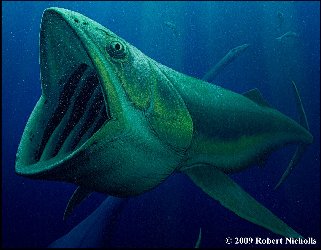 |
Bonnerichthys gladius is a new genus of giant filter
feeding fish described from the Smoky Hill Chalk by Friedman, et al. 2010 in
Science (2010) and more recently in the Journal of Vertebrate
Paleontology:
Friedman, M., Shimada, K., Martin, L., Everhart, M.J., Liston, J., Maltese, A. and Triebold, M. 2010. 100-million-year dynasty of giant planktivorous bony fishes in the Mesozoic seas. Science 327:990-993. Story on the discovery by the Bonner Family in the Wichita Eagle Chosen as one of the 100 top stories of 2010 by Discover Magazine Friedman, M., Shimada, K., Everhart, M.J., Irwin, K.J., Grandstaff, B.S. and Stewart, J.D. 2013. Geographic and stratigraphic distribution of the Late Cretaceous suspension-feeding bony fish Bonnerichthys gladius (Teleostei, Pachycormiformes). Journal of Vertebrate Paleontology 33:35-47. |
|
|
What Should Everyone Know About Paleontology? - Guest commentary by Thomas R. Holtz, Jr. |
 |
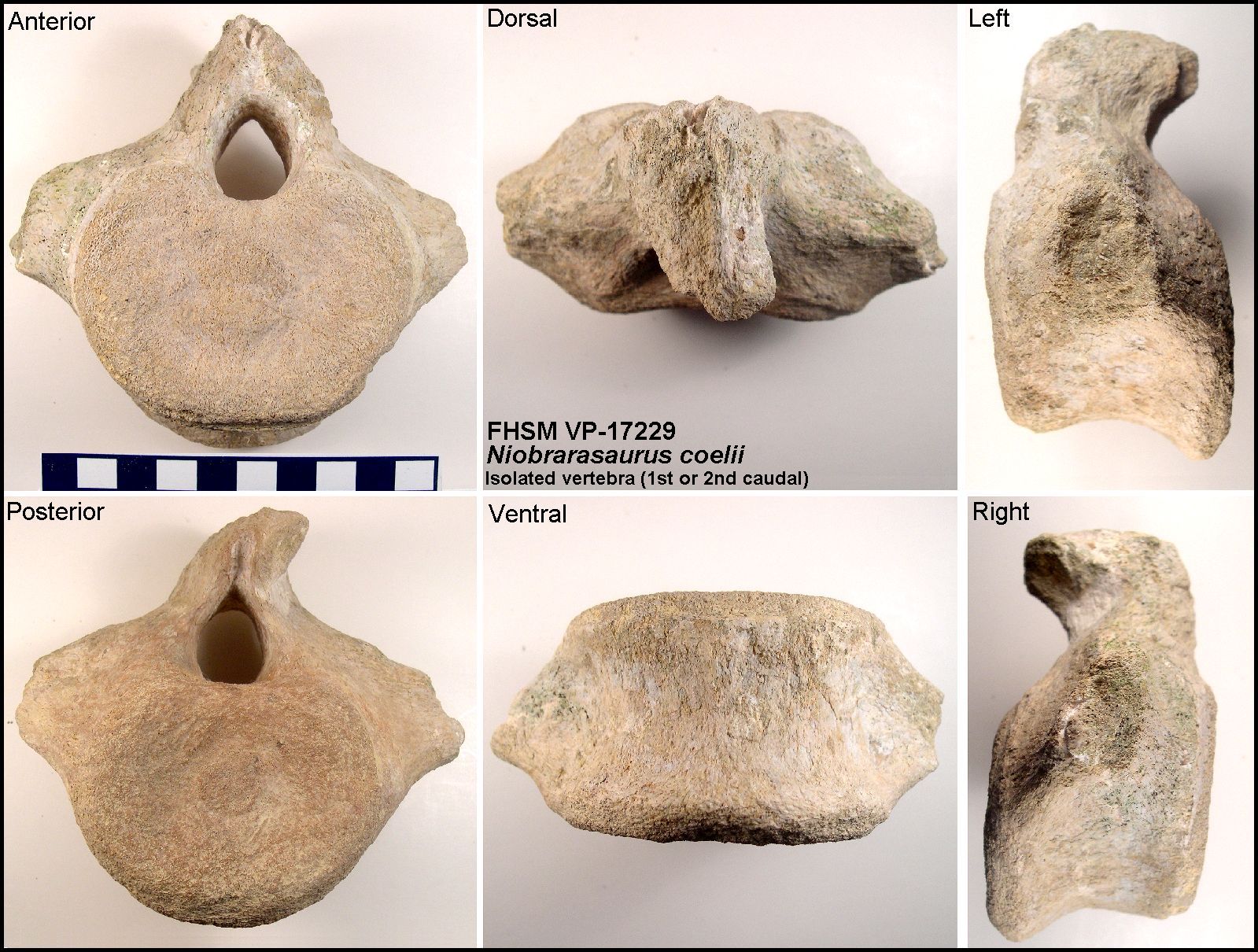
Although, with one known exception, dinosaurs did not live in Kansas, some of them died and floated into the Western Interior Sea over Kansas. LEFT: An articulated series of nine caudal vertebrae (FHSM VP-15824) in left (upper) and right lateral view from a shark scavenged hadrosaur discovered in the Smoky Hill Chalk of western Kansas by Keith Ewell, June, 2005. RIGHT: An isolated caudal vertebra from a large Niobrarasaurus coleii (FHSM VP-17229) collected by Laura Garrett in 2007 from southwestern Trego County, KS. |
 |
 |
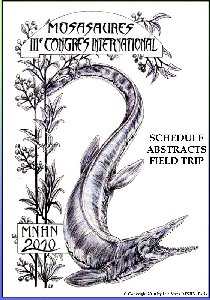
2nd Mosasaur Meeting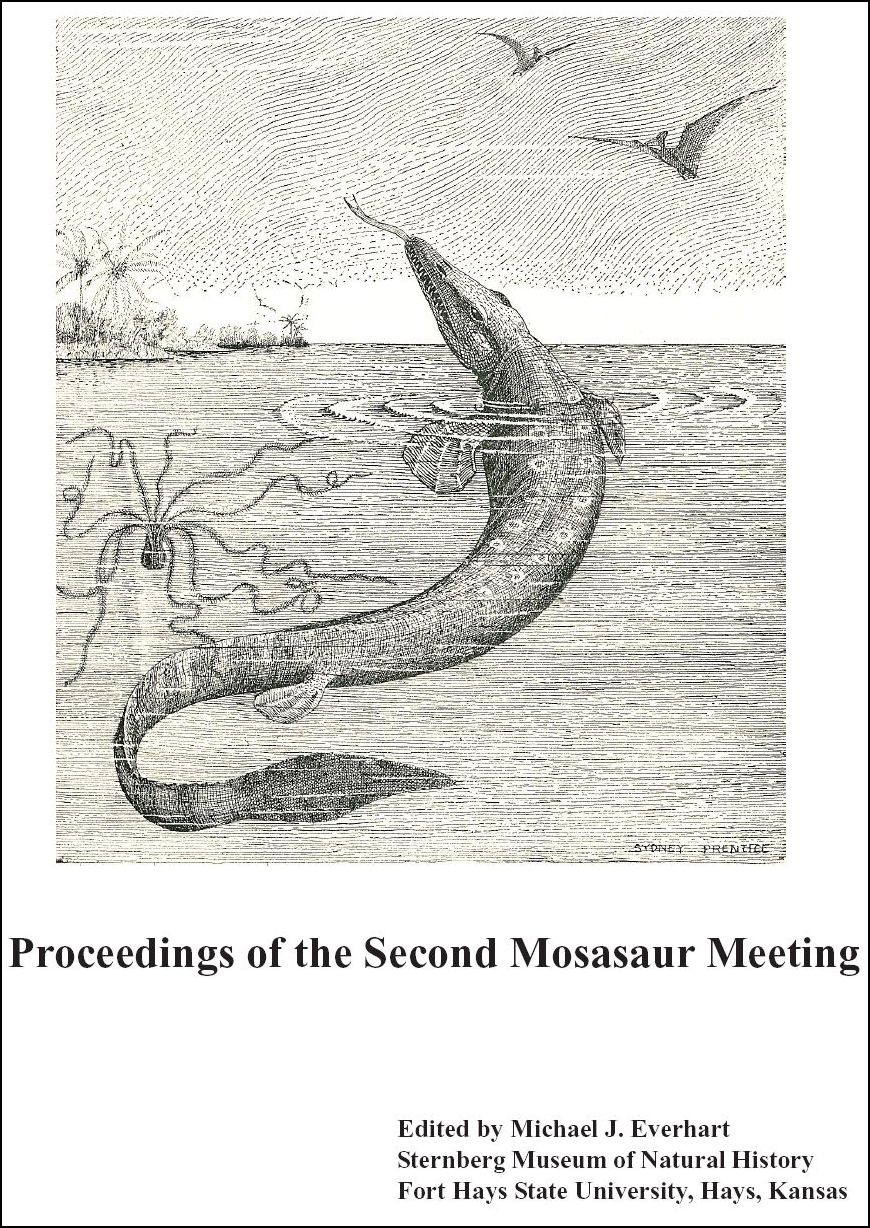 |
The Proceedings of the Second Mosasaur Meeting (2008) edited by Michael J. Everhart, Sternberg Museum of Natural History, have now been published. The contents of the volume, including the naming of two new species, are shown online here: The 172 page volume is available for purchase at the Sternberg Museum store for $19.95 plus tax. (Shipping per Priority Mail) Credit card purchases can made through Brad Penka: Phone: 785-628-5569 or Email: Bpenka (at) fhsu.edu Write Brad Penka for more information, Sternberg Museum of Natural History, 3000 Sternberg Drive, Hays, Kansas 67601-2006. ABSTRACT BOOKLET HERE (500 KB) - The First Mosasaur Meeting, Maastricht, The Netherlands, May, 2004 |
3rd Mosasaur Meeting
|
|
RECENT PUBLICATIONS (See complete list on Google Scholar): NEW Everhart, M.J. 2017. Oceans of Kansas. Natural History Magazine 126(1):29-33. NEW Everhart, M.J. 2017. Oceans of Kansas - A Natural History of the Western Interior Sea, 2nd Ed., Indiana University Press, 427 pp. NEW Everhart, M.J. 2017. When the amber waves were blue. Konza Journal 51, 10 pp. NEW Everhart, M.J. 2017. Captain Theophilus H. Turner and the unlikely discovery of Elasmosaurus platyurus. Transactions of the Kansas Academy of Science 120(3-4):233-246. NEW Davidson, J.P. and Everhart, M.J.
2017. Scattered and shattered: A brief history of the early methods of digging,
preserving and transporting Kansas fossils. Transactions of the Kansas Academy
of Science 120(3-4):247-258. NEW Everhart, M.J. 2017. Joseph Savage
(1823-1891): Abolitionist, Kansas pioneer, horticulturist, fossil collector.
Transactions of the Kansas Academy of Science 102(1-2):45-56. NEW Everhart, M.J. 2016. William E. Webb – Civil War correspondent, railroad land baron, town founder, Kansas legislator, adventurer, fossil collector, author. Kansas Academy of Science, Transactions 119(2):179-192. Everhart, M.J. 2016. Rare occurrence of a mosasaur (Squamata: Mosasauridae) remains in the Blue Hill Shale (Middle Turonian) of Mitchell County, Kansas. Kansas Academy of Science, Transactions 119(3-4):375-380. Everhart, M.J. 2015. Elias Putnam West (1820-1892) - Lawyer, Attorney General, militia commander, judge, postmaster, archaeologist, and paleontologist. Kansas Academy of Science, Transactions 118(3-4):285-294. Hoganson, J.W., Erickson, J.M. and Everhart, M.J. 2015. Ischyodus rayhaasi (Chimaeroidei; Callorhynchidae) from the Campanian-Maastrichtian Fox Hills of northeastern Colorado, U.S.A. Kansas Academy of Science, Transactions 118(1-2):27-40. Ikejiri, T. and Everhart, M.J. 2015. Notes on the authorship and the holotype of the Late Cretaceous durophagous shark Ptychodus mortoni (Chondrichthyes, Ptychodontidae). pp. 69-73 in Sullivan, R.M. and Lucas, S.G.(eds.), Fossil Record 4. New Mexico Museum of Natural History and Science Bulletin 67. Everhart, M.J. and Pearson, G. 2014. An isolated squamate dorsal vertebra from the Late Cretaceous Greenhorn Formation of Mitchell County, Kansas. Kansas Academy of Science, Transactions 117(3-4):261-269. OGorman, J.P., Olivero, E.B., Santillana, S. and Everhart, M.J. 2014. Gastroliths associated with an Aristonectes specimen (Plesiosauria, Elasmosauridae), López de Bertodano Formation (upper Maastrichtian) Seymour Island (Is. Marambio), Antarctic Peninsula. Cretaceous Research 50:228-237.
Davidson, J.P and Everhart, M.J. 2014. Fictionalized facts; "The Young Fossil Hunters" by Charles H. Sternberg. Kansas Academy of Science, Transactions 117(1-2):41-54.
Goldfuss, A. 2013. The skull structure of the Mosasaurus, explained by means of a description of a new species of this genus. Kansas Academy of Science, Transactions 116(1-2):27-46. (Everhart, M.J., Editor)
Cook, T.D, Wilson, M.V.H., Murray, A.M., Plint, A.G., Newbrey, M.G. and Everhart, M.J. 2013. A high latitude euselachian assemblage from the early Turonian of Alberta, Canada. Journal of Systematic Palaeontology 11(5):555-587. Everhart, M.J. 2013. A new specimen of the marine turtle, Protostega gigasCope (Cryptodira; Protostegidae), from the Late Cretaceous Smoky Hill Chalk of Western Kansas. Kansas Academy of Science, Transactions 116(1-2):73. Sachs, S., Kear, B.P., and Everhart, M.J. 2013. Revised vertebral count in the longest-necked vertebrate Elasmosaurus platyurus Cope 1868, and clarification of the cervical-dorsal transition in Plesiosauria. PLoS ONE 8(8): 6 pp. LINK
Schumacher, B.A., Carpenter, K. and Everhart, M.J. 2013. A new Cretaceous Pliosaurid (Reptilia, Plesiosauria) from the Carlile Shale (middle Turonian) of Russell County, Kansas, Journal of Vertebrate Paleontology 33(3):613-628
Everhart, M.J. 2013. The Palate Bones of a Fish? The First Specimen of Ptychodus mortoni (Chondrichthyes; Elasmobranchii) from Alabama. Bulletin of the Alabama Museum of Natural History 31(1):98-104.
Friedman, M., Shimada, K., Everhart, M.J., Irwin, K.J., Grandstaff, B.S. and Stewart, J.D. 2013. Geographic and stratigraphic distribution of the Late Cretaceous suspension-feeding bony fish Bonnerichthys gladius (Teleostei, Pachycormiformes). Journal of Vertebrate Paleontology 33:35-47.
Schumacher, B.A., Carpenter, K., and Everhart,
M.J. 2012. A new pliosaur (Plesiosauria, Pliosauridae) from the Carlile
Shale (Cretaceous, Middle Turonian) of Russell County, Kansas. Supplement
to the online Journal of Vertebrate Paleontology ISSN 1937-2809, pp. 168-169. Vullo, R., Buffetaut, E. and Everhart, M.J. 2012. Reappraisal of Gwawinapterus beardi from the Late Cretaceous of Canada: A saurodontid fish, not a pterosaur. Journal of Vertebrate Paleontology 32(5):1198-1201. Lindgren, J., Everhart, M.J. and Caldwell, M.W. 2011. Three-dimensionally preserved integument reveals hydrodynamic adaptations in the extinct marine lizard Ectenosaurus (Reptilia, Mosasauridae). PLoS One. Everhart, M.J., Hageman, S.A. and
Hoffman, B.L. 2010. Another Sternberg fish-within-a-fish discovery:
First report of Ichthyodectes ctenodon (Teleostei;
Ichthyodectiformes) with stomach contents. Kansas
Bourdon,
J. and Everhart, M.J. 2010. Occurrence
of the extinct Carpet shark, Orectoloboides, in the Dakota Formation
(Late Cretaceous; Middle Cenomanian) of Everhart, M.J. and Maltese, A. 2010. First report of a heteromorph ammonite, cf. Glyptoxoceras, from the Smoky Hill Chalk
(Santonian) of western
Everhart, M. J. 2010. Bonnerichthys gladius – The largest bony fish and first known planktivore from the Late Cretaceous. Kansas Academy of Science, Transactions 113(1-2):123-124 (abstract). Friedman, M., Shimada, K., Martin, L., Everhart, M.J., Liston, J., Maltese, A. and Triebold, M. 2010. 100-million-year dynasty of giant planktivorous bony fishes in the Mesozoic seas. Science 327:990-993. Shimada, K., Everhart, M.J., Decker, R. and Decker, P.D. 2009. A
new skeletal remain of the durophagous shark, Ptychodus
mortoni, from the Upper Cretaceous of Everhart,
M.J. 2009. First occurrence of marine vertebrates in the Early Cretaceous of Everhart,
M.J. 2009. Probable plesiosaur remains from the Blue Hill Shale (Carlile Formation; Middle
Turonian) of north central Everhart, M.J. and Bell, A. 2009. A hesperornithiform limb bone from the basal Greenhorn Formation (Late Cretaceous; Middle Cenomanian) of north central Kansas. Journal of Vertebrate Paleontology 28(3):952-956. Bell, A. and Everhart, M.J. 2009. A new specimen of Parahesperornis (Aves: Hesperornithiformes) from the Smoky Hill Chalk (Early Campanian) of western Kansas. Kansas Academy of Science, Transactions 112(1/2):7-14. Shimada, K. and Everhart, M.J. 2009. First record of Anomoeodus (Osteichthyes: Pycnodontiformes) from the Upper Cretaceous Niobrara Chalk of western Kansas. Kansas Academy of Science, Transactions 112(1/2):98-102. Everhart, M.J. 2008. A bitten skull of Tylosaurus kansasensis (Squamata: Mosasauridae) and a review of mosasaur-on-mosasaur pathology in the fossil record. Kansas Academy of Science, Transactions 111(3/4):251-262 Everhart, M.J. (ed.). 2008. Proceedings of the Second Mosasaur Meeting. Fort Hays Studies Special Issue 3, Fort Hays State University, Hays, Kansas, 172 pp. Everhart, M.J. 2008. The mosasaurs of George F. Sternberg, paleontologist and fossil photographer. Proceedings of the Second Mosasaur Meeting, Fort Hays Studies Special Issue 3, Fort Hays State University, Hays, Kansas, pp. 37-46. Polcyn, M.J. and Everhart, M.J. 2008. Description and phylogenetic analysis of a new species of Selmasaurus (Mosasauridae: Plioplatecarpinae) from the Niobrara Chalk of western Kansas. Proceedings of the Second Mosasaur Meeting, Fort Hays Studies Special Issue 3, Fort Hays State University, Hays, Kansas, pp. 13-28. Polcyn, M.J., Bell, G.L., Jr., Shimada, K. and Everhart, M.J. 2008. The oldest North American mosasaurs (Squamata: Mosasauridae) from the Turonian (Upper Cretaceous) of Kansas and Texas with comments on the radiation of major mosasaur clades. Proceedings of the Second Mosasaur Meeting, Fort Hays Studies Special Issue 3, Fort Hays State University, Hays, Kansas, pp. 137-155. Everhart, M.J. 2008. Rare occurrence of a Globidens sp. (Reptilia; Mosasauridae) dentary in the Sharon Springs Member of the Pierre Shale (Middle Campanian) of Western Kansas. p. 23-29 in Farley G. H. and Choate, J.R. (eds.), Unlocking the Unknown; Papers Honoring Dr. Richard Zakrzewski, , Fort Hays Studies, Special Issue No. 2, 153 p., Fort Hays State University, Hays, KS.
Everhart, M. J. 2007. New stratigraphic records (Albian-Campanian) of the guitarfish, Rhinobatos sp. (Chondrichthyes; Rajiformes), from the Cretaceous of Kansas. Kansas Academy of Science, Transactions 110(3-4): 225-235.
Everhart, M. J. 2007. Historical note on the 1884 discovery of Brachauchenius lucasi (Plesiosauria; Pliosauridae) in Ottawa County, Kansas. Kansas Academy of Science, Transactions 110(3-4):255-258.
Everhart, M. J. 2007. Sea Monsters: Prehistoric Creatures of the Deep. National Geographic, 192 p. ISBN-13: 978-1426200854
Everhart, M. J. 2007. Remains of a pycnodont fish (Actinopterygii: Pycnodontiformes) in a coprolite; An upper record of Micropycnodon kansasensis in the Smoky Hill Chalk, western Kansas. Kansas Academy of Science, Transactions 110(1/2): 35-43. Everhart, M. J. 2007. Use of archival photographs to rediscover the locality of the Holyrood elasmosaur (Ellsworth County, Kansas). Kansas Academy of Science, Transactions 110(1/2): 135-143. AVAILABLE ON-LINE AS A FREE PDF: Everhart, M.J. 2005. Tylosaurus kansasensis, a new species of tylosaurine (Squamata: Mosasauridae) from the Niobrara Chalk of western Kansas, U.S.A. Netherlands Journal of Geosciences / Geologie en Mijnbouw, 84(3), p. 231-240. |
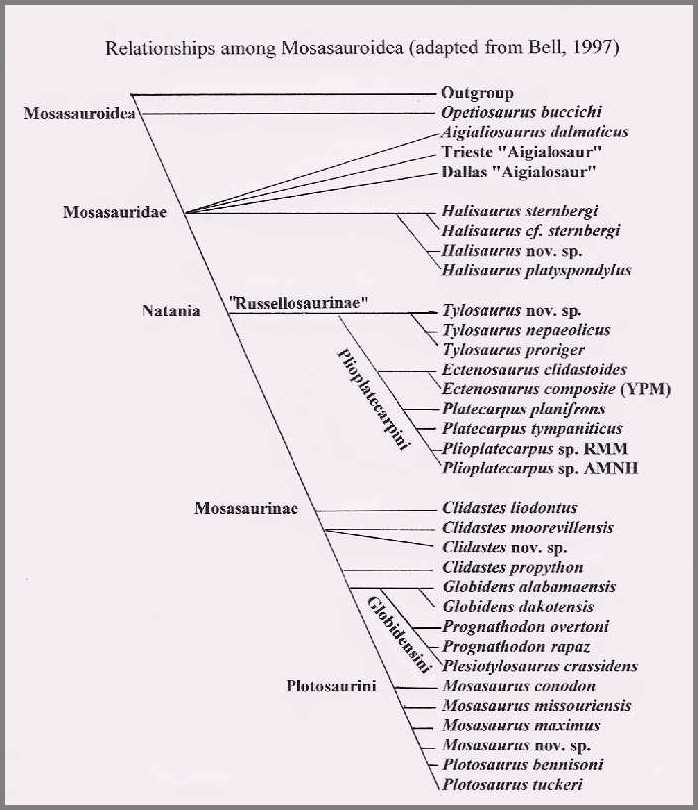
Oceans of Kansas is NOT about dinosaurs. Although the type specimen of Niobrarasaurus coleii was found in Kansas, this web site has very little information about dinosaurs. I do recommend some excellent dinosaur sites on the Oceans of Kansas Linkspage. For more information about the origin of mosasaur and plesiosaur names, go to Ben Creisler's Translation and Pronunciation Guide, a recent addition to the The Dinosauria On-Line Dinosaur Omnipedia. John Damuth's Bibliography of Fossil Vertebrates (BFV) is HERE. Click here for the most current view on the relationships of American mosasaurs. Also go HERE for a more detailed cladogram on Mikko Haaramo's Phylogeny Archive webpage.
For a fictional story about the daily life of a mosasaur, CLICK HERE. If you are interested in fossil insects, visit Roy Beckemeyer's "Winds of Kansas" webpage.
.... and for a new paleontology blog by Greg Liggett, visit the BoneBlogger
| Table of Contents | Handy paleo-reference page | Search with Google |
|
If you would like to learn more about paleontology in Kansas, you
might consider joining the
Kansas Academy of Science, It's inexpensive ($35 per year) and we have a variety
of paleontology papers in the process of being published. Click
here for an updated list of KAS publications on paleontology |
|
|
|
SCHEDULE, REGISTRATION AND ABSTRACT SUBMITTAL INFORMATION HERE: The 18th Annual Paleontology Symposium
will be held at the 149th Annual Meeting See abstracts from the 2014 Paleo-symposium here
Larry Dean Martin (1943-2013) - Renaissance Paleontologist (PDF - 1.8 MB)
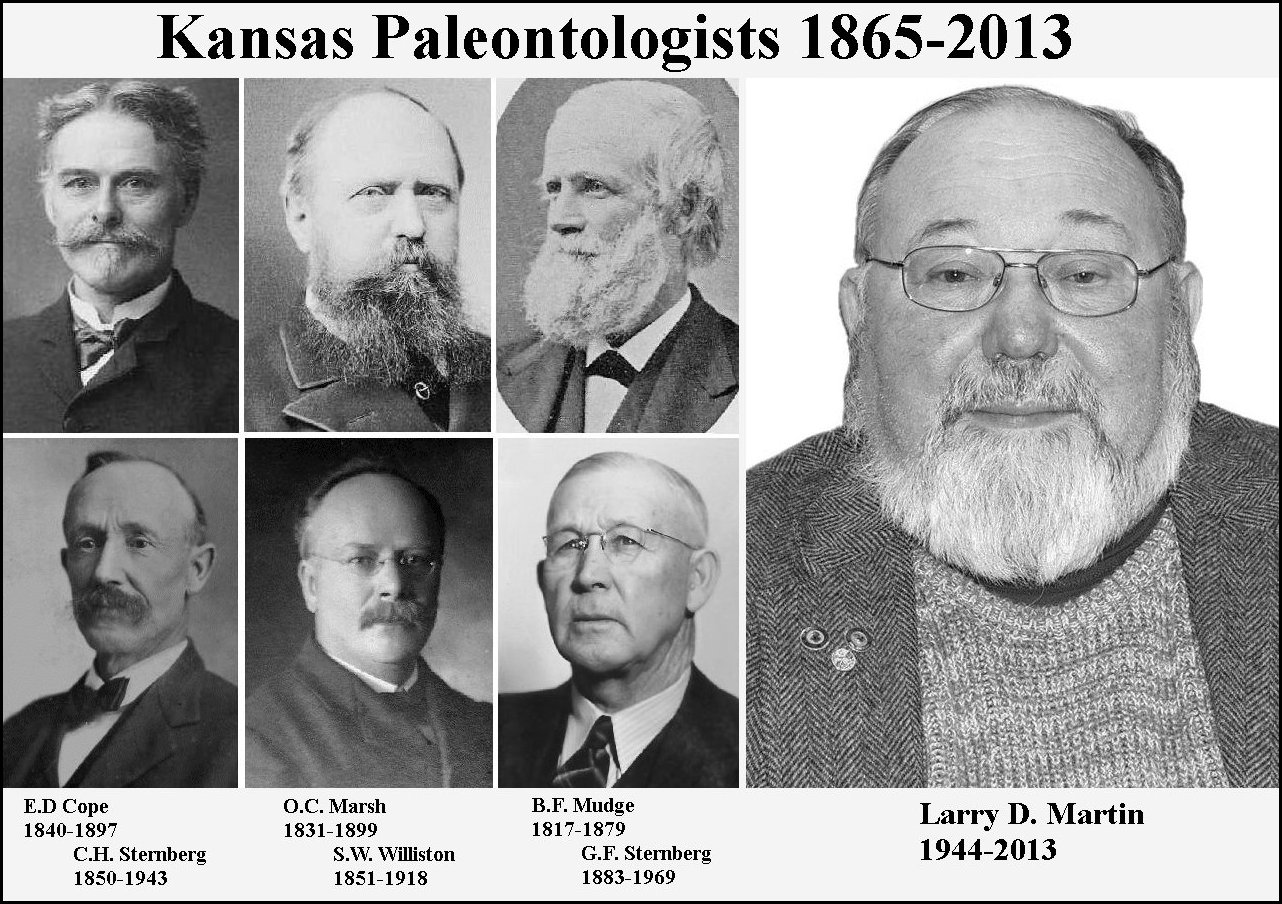
LEFT: Well known paleontologists who have discovered fossils in Kansas |
|
Systematics and morphology of American mosasaurs by Dale Russell "The best publication about mosasaurs" |
The Yale Peabody Museum Publications Office is pleased to announce
that the 1967 monograph, "Systematics and Morphology of American Mosasaurs"
by Dale Russell, Peabody Museum of Natural History, Yale University, Bulletin 23, is now
available as a facsimile reprint through the Yale Peabody Museum web site. The museum regularly receives requests for this title, which is the first of several of out-of-print publications that will be made available to the worldwide academic community through Yale's print-on-demand service. (Go to the Publications link at http://www.peabody.yale.edu). |
| QUICK SITE INDEX | Smoky Hill Chalk Field Guides: Invertebrates; Fish; Marine Reptiles; Pteranodons, Dinosaurs and Birds; Other |
 Oceans of Kansas
webpages (mostly about sharks) translated into French by Jean-Michel Benoit
Oceans of Kansas
webpages (mostly about sharks) translated into French by Jean-Michel Benoit
| TABLE OF CONTENTS | WHAT'S NEW AT OCEANS OF KANSAS? | OOK LINKS |
07/05/2012 Ben Creisler's Plesiosaur Pronunciation Guide - Moved to Oceans of Kansas
07/05/2012 Ben Creisler's Mosasaur Pronunciation Guide - Moved to Oceans of Kansas
01/02/2012 The Last Pliosaur - Megacephalosaurus eulerti discovered in the Blue Hill Shale
11/28/2011 Inoceramids - Giant Cretaceous clams from the Smoky Hill Chalk
11/16/2011 Ectenosaurus clidastoidesmosasaur with preserved skin
10/24/2011 Protostega gigas - A new discovery in the Smoky Hill Chalk of Gove County
08/15/2011 Kiowa Shale Field Trip: Plesiosaurs
07/15/2011 Tusoteuthis longa - The elusive Niobrara squid....
05/10/2011 Kansas Crocodiles - Life along the edge of the Western Interior Sea
10/27/2010 Ptychodus mortoni - New shell crushing shark specimen from the Smoky Hill Chalk
06/09.2010 Cretodus crassidens - Late Cretaceous Shark Collected from the Blue Hill Shale of Mitchell County, Kansas
04/19/2010 Kansas Ammonites.... - Something like a squid in a coiled shell
10/26/2008 Remains of young mosasaurs from the Smoky Hill Chalk - It was a dangerous place to be born....
09/13/2008 Digging up a large turtle in the Fairport Chalk - Probable first collection of the skull of Desmatochelys lowii from Kansas.
09/10/2008 The brain and back of the skull of mosasaurs - A primer on the complicated anatomy....
07/13/2008 First polycotylid plesiosaur from the Fort Hays Limestone - (Early Coniacian) - Jewell County, Kansas.
04/27/2008 Baptornis advenus Marsh 1877, a marine bird from the western Interior Sea. (Smaller, more primitive than Hesperornis.
04/18/2008 A complete mosasaur skeleton - Osseous and cartilaginous. Osborne, 1899 - Early photographs of Tylosaurus proriger
MORE OCEANS OF KANSAS LINKS HERE
| PalArch - Web-based scientific journal | The Paleontology Portal - Lots of fossil specimens | Greg Liggett's BoneBlogger |
|
Robert Randell's British Chalk Fossils |
Richard Forrest's Plesiosaur.com |
Adam Smith's The Plesiosaur Directory |
|
Roy Beckemeyer's Winds of Kansas - Fossil insects |
||
|
Ammonites (in French) |
Rudists (Durania maxima) |
NEW More insects from the Eocene Green River Formation - NW Colorado |
| Paleontology Museums |
| There are also many links to other excellent paleo web pages and museum sites around the world, so please plan on taking some time to see what is available. Also, don't forget to bookmark this page so that you can come back occasionally to see what has been added. The two best ways to 'surf' the Oceans of Kansas site are to use the Table of Contents pages, or the Links to this site and other paleontology web pages. There are also 'hyper-links' embedded in the text on most of the pages that will take you to other sub-pages for more information on that subject. These links are highlighted in a different color (light blue) and are 'click-able'. From the Links page, you can surf the net to sites all over the world, but please take a tour of Oceans of Kansas Paleontology first. To get things started, let's take a look at: |
 |
Click on the Pteranodon to take the unofficial Oceans of KansasA "virtual tour" of theSternberg Museum of Natural History (Click for official web page) |
|
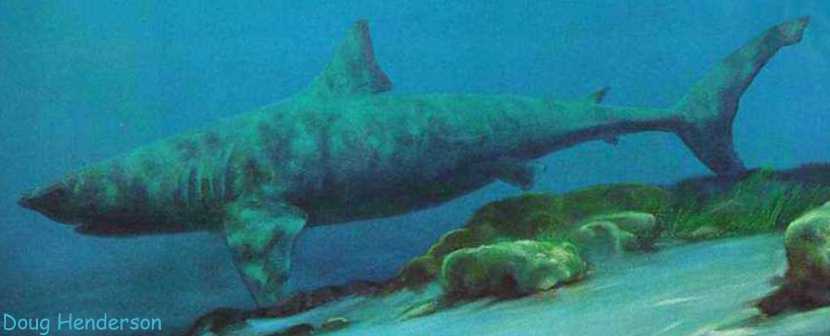
Yes, Virginia, there were lots of sharks in Kansas Click here to see more of Doug Henderson's Paleo-Life Art |
 |
You can now download a FREE pdf copy of this early article on Kansas Sharks by Williston - Provided by the Kansas Geological Survey.
Williston, S. W. 1900. Cretaceous fishes: Selachians and Pycnodonts. University Geological Survey Kansas VI pp. 237-256, with pls.
 |
The Cretaceous Period lasted
from about 144 million years ago to 65 million years ago. In Kansas, it is
represented by marine and estuarine deposits from the Early Cretaceous (Albian)
Cheyenne Sandstone and Kiowa Shale that overlay the Wellington Formation (Permian)
or the Morrison Formation (Jurassic) at the base, to the Pierre Shale at the top. (See Kansas Geology Map and Time Scale).
A brief Cretaceous Time Scale is found here. The 1999 version
of the GSA (Geological Society of America)
geologic time scale is found HERE as a printable .pdf file (233 kb).
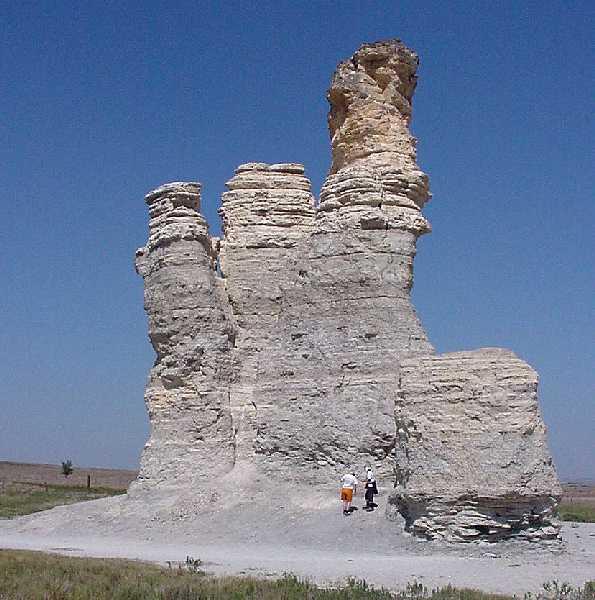
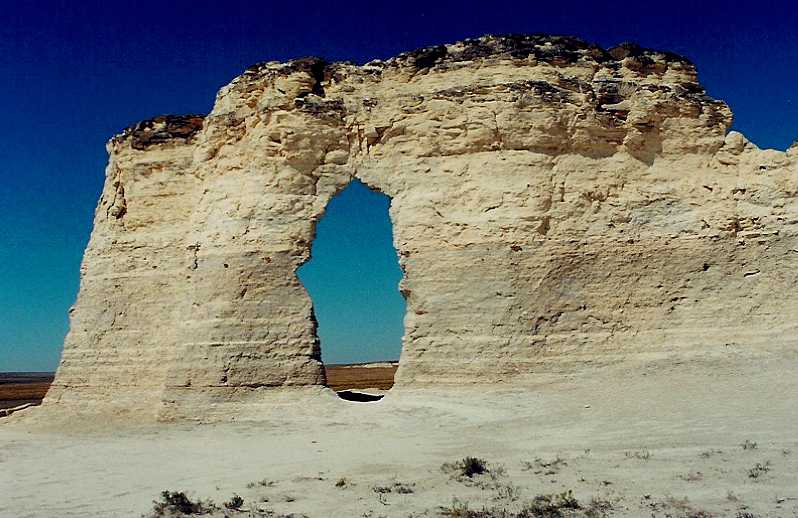
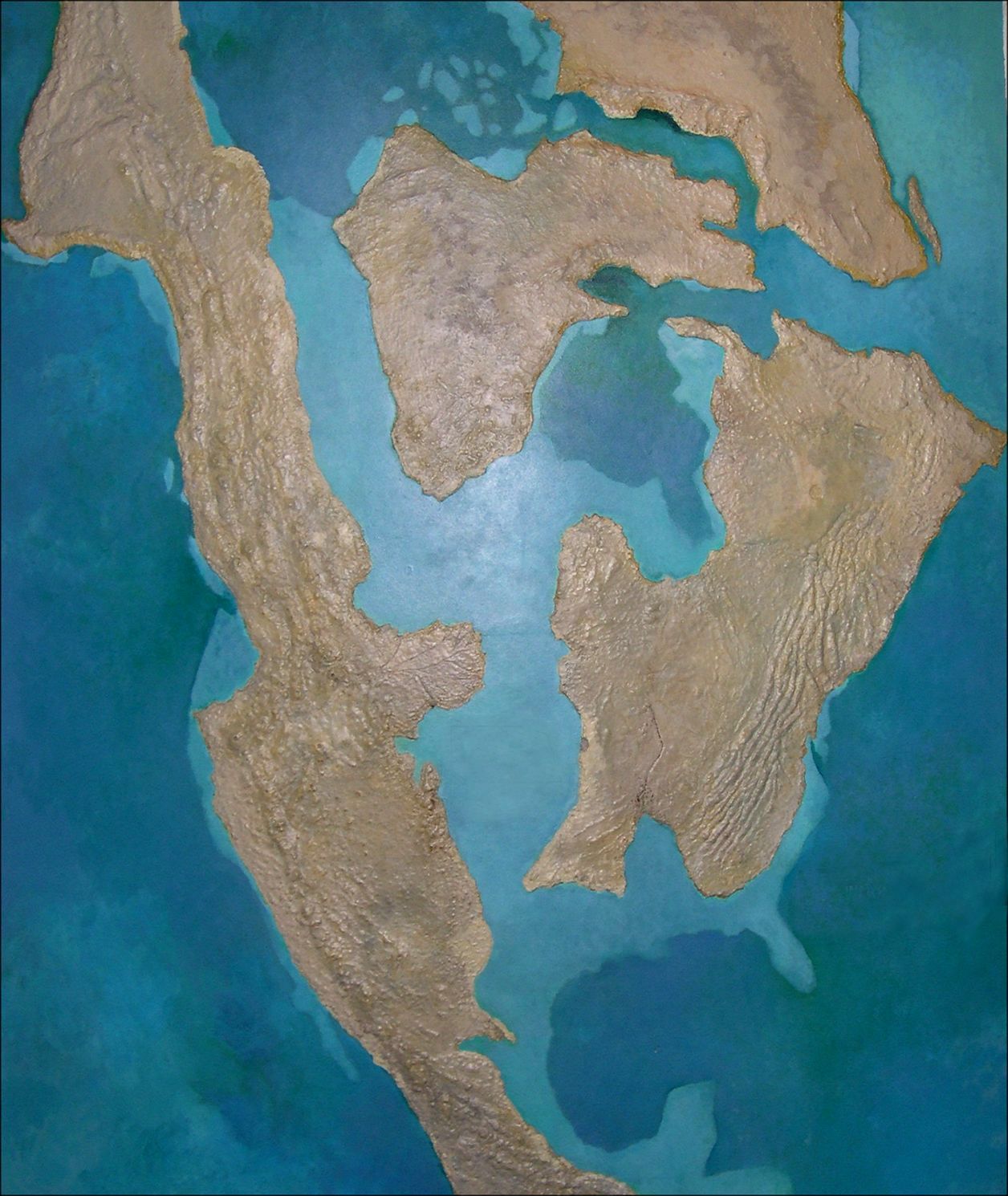
A major part of the upper portion (Late Cretaceous) of these deposits is referred to as the Niobrara Formation. It contains a rather unique member called the Smoky Hill Chalk, and provides the exposures for two Kansas landmarks: Castle Rock and Monument Rocks. The chalk found in Kansas was deposited between 87 and 82 million years ago during a period when a shallow inland sea (the Western Interior Sea) covered most of the Midwest from the Gulf of Mexico to the Arctic Circle. The deposition of these chalky, marine sediments occurred during the last half of the Cretaceous Period, approximately 15-20 million years before the end of the Age of Dinosaurs. The Smoky Hill Chalk member is about 600 feet thick in Kansas, and lies conformably above the Fort Hays Limestone, and below the Pierre Shale. For the most part, the chalk is composed of the compacted shells (coccolithophores) and plates (coccoliths) of an abundant, microscopic, golden-brown algae (Chrysophyceae) that lived in the clear waters of a warm, shallow sea. A large percentage of the chalk is made up of coprolites containing coccoliths from the animals that fed on the algae. |
| A generalized map of the North American continent during late Cretaceous time. The Western Interior Sea covered most of the Midwest from the present Gulf of Mexico to the Arctic. (Map modified from an exhibit at the University of Nebraska State Museum) |
The Western Interior Sea,sometimes called the Inland Sea, was probably less than 600 feet deep in most areas, and had a relatively flat and soft, mud bottom. It is considered to be an 'epi-continental sea'; that is, one which lies on top of a continental landmass, and not between continents. Near the middle of the sea where Kansas is now located, sediments were deposited at a rate which would ultimately produce about one inch of compacted chalk for every 700 years. The chalk also has more than a hundred thin layers of bentonite clay, most of which are rusty red in color, that are the result of the fall of ash from repeated eruptions of volcanoes to the west of Kansas in what is now Nevada and Utah. These ash deposits can be traced for miles across the chalk beds and have been used as marker units in describing the stratigraphy of the formation (See Hattin, 1982). In addition, several species of vertebrate and invertebrate marine life that lived and/or became extinct at certain times during the deposition of the chalk are useful in determining the age and biostratigraphy of widely separated exposures (See Stewart, 1990). Near the end of the Cretaceous, the Western Interior Sea began to close, becoming shallower and narrower as the Rocky Mountains were pushed up from the west, uplifting the sea bottom as they rose. Eventually, the center of North America rose above sea level and the sediments (limestones, sandstones, shales and chalk) deposited on the basement rocks of Kansas for nearly half a billion years began to erode away.
 |
A map of Kansas showing the surface and sub-surface
distribution of the remaining Cretaceous rocks (adapted from the Kansas Geological Survey
Bulletin 162; 1963). Although Kansas was once nearly covered with Cretaceous marine
deposits, millions of years of erosion have removed a
large portion of them them from the surface, leaving many areas of chalk exposed along river valleys in the northwest portion of
the State. Go here for more information on Kansas Geology.
KANSAS FOSSILS - Kansas Geological Survey
|
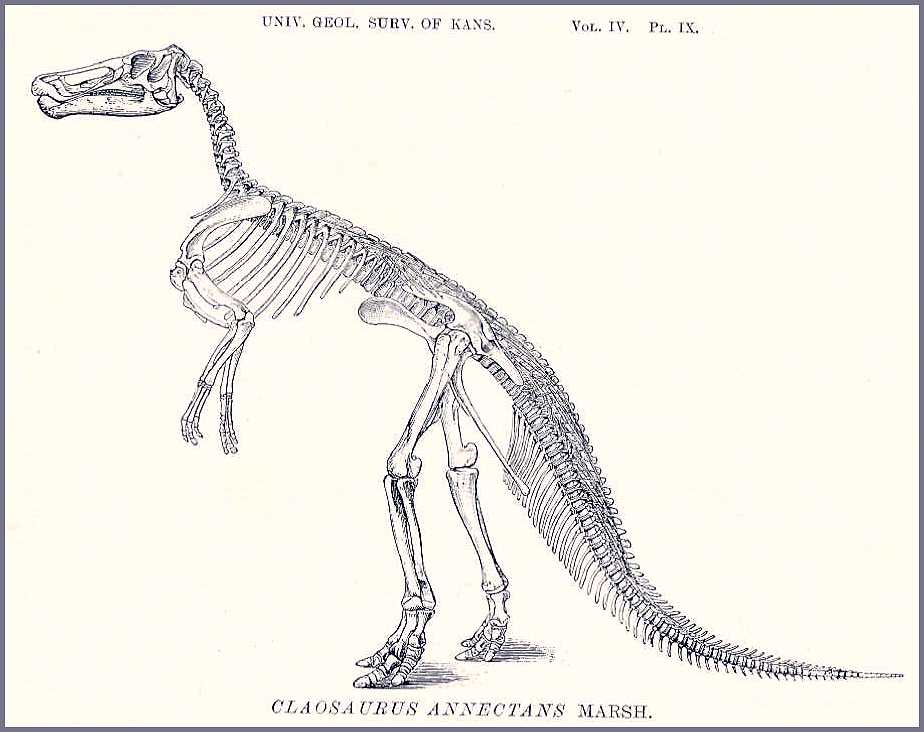
This shallow ocean was home to a variety of marine animals, almost all of which are now extinct. These included giant clams, rudists, crinoids, squid, ammonites, numerous sharks and bony fish,turtles, plesiosaurs, mosasaurs , Pteranodons and even several species of marine (toothed) birds. Although it seems unlikely that you would find dinosaur fossils in the middle of the Western Interior Sea, a number of them (a hadrosaur found by O. C. Marsh in 1871, and several nodosaurs, includingthe type specimen of Niobrarasaurus coleii) have been collected from the Smoky Hill Chalk, and their remains have been well documented. The bodies of these dinosaurs must have somehow floated hundreds of miles into the sea before sinking to the bottom or being torn apart by scavenging sharks. It is possible that they died during catastrophic flooding on the land masses to the east or west, and were carried out to sea on a large, tangled mat of trees and other vegetation (fossilized wood, including large logs, is also known from the chalk).
Over a period of about five million of years, the remains of many of these animals were preserved as fossils in the soft, chalky mud of the sea bottom. When this mud was compressed under thousands of feet overlying shale, it became a deposit of chalk that is more than 600 feet thick in Western Kansas. Most of the massive chalk formation that once covered Kansas, however, has been eroded away over the last 60 million years and is now exposed only in a relatively small area in the northwestern corner of the State. This part of Kansas is also known as the Smoky Hills.
Since 1868 and the discovery of Tylosaurus proriger, the Smoky Hill Chalk has been the source of thousands of fossil specimens, many of which are on exhibit today in museums around the world. The first significant collections of Kansas fossils were made by relatively unknown scientists like Professor Benjamin F. Mudge, Dr. George M. Sternberg, Dr. John Janeway, and Dr. Theophilus H. Turner. Many others were collected by and for such famous paleontologists as Edward Drinker Cope, O. C. Marsh, Samuel W. Williston, and Charles Sternberg, (for more information on the Sternberg family, click here), including a large portion of the Yale Peabody Museum collection that resulted from the Yale College Scientific Expeditions of the 1870s. For some 'old time' advice on collecting fossils, see an 1884 article by Charles H. Sternberg here. Much of the early work on mosasaurs in Kansas was published in The University Geological Survey of Kansas in the late 1890's. A large number have been found since then by amateur collectors and many of these have been significant additions to paleontology. The Sternberg Museum of Natural History at Fort Hays State University, the Museum of Natural History at The University of Kansas, and the University of Nebraska State Museum have excellent collections of fossils from the Smoky Hill Chalk. The Denver Museum of Nature and Science, the Sam Noble Museum of Natural History in Norman, Oklahoma, the Field Museum of Natural History in Chicago, the Philadelphia Academy of Natural Sciences, and the American Museum of Natural History also have many Kansas fossils. Click here for additional information about some early American paleontologists.
RECOMMENDED RECENT BOOKS ON PALEONTOLOGY
 |
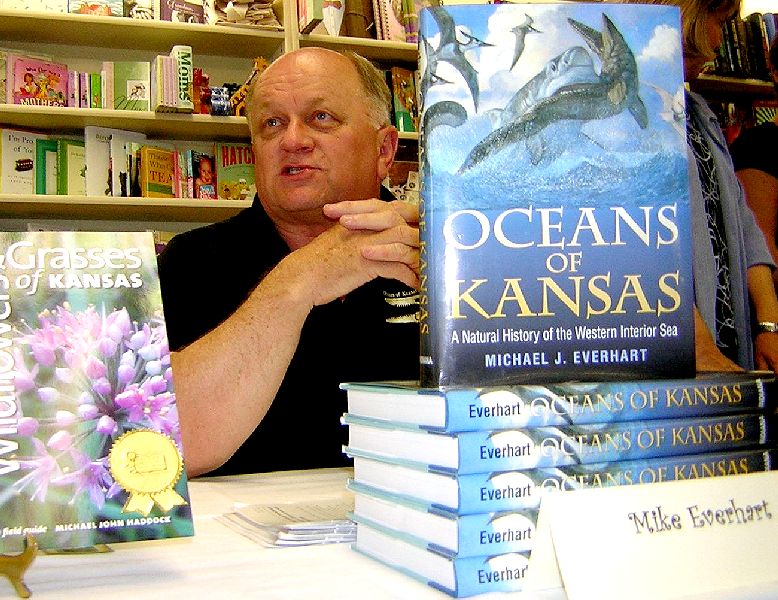
Oceans of Kansas is now available as a book. OCEANS OF KANSAS - A Natural History of the Western Interior Sea. by Michael J. Everhart, published June, 2005 by the Indiana University Press ISBN: 0253345472 "A journey to a time when sea monsters roamed the middle of America" Oceans of Kansas was named the featured book from Kansas for the 2006 National Book Festival in Washington, D.C. It was also a featured book of the Discovery Channel Book Club and is currently in its 3rd Printing by the Indiana University Press... over 6000 copies sold! RIGHT: Photo by Cheryl Unruh of Flyover People from a book-signing in June, 2007. Used with permission: |
 |
 |
Sea Monsters: Prehistoric Creatures of the Deep By Mike Everhart Awarded 2008 by the American Library Association Awarded as a 2008 Kansas Notable Book |
Proceedings of the Second Mosasaur Meeting Edited by Michael J. Everhart Published by Fort Hays State University, 2008 172 pp. |
|
 |
King of the Crocodylians The Paleobiology of Deinosuchus David R. Schwimmer Published 2002 by the Indiana University Press, 220 pages |
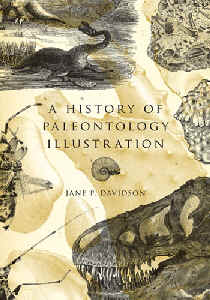 |
NEW!! A History of Paleontology Illustration Jane P. Davidson Published 2008 by the Indiana University Press, 217 pages |


|
|